
Device
AliExpress 433 MHz copy remote
Published · Updated
A 4-button “duplicator” remote from AliExpress, sold to copy other 433 MHz gate and garage remotes. I bought it as a spare for our gate remote. It couldn’t learn it: the gate remotes send a rolling code, and their brand isn’t on its list. I then used it as the test transmitter for my CC1101 scanner, since its own code is simple and fixed.
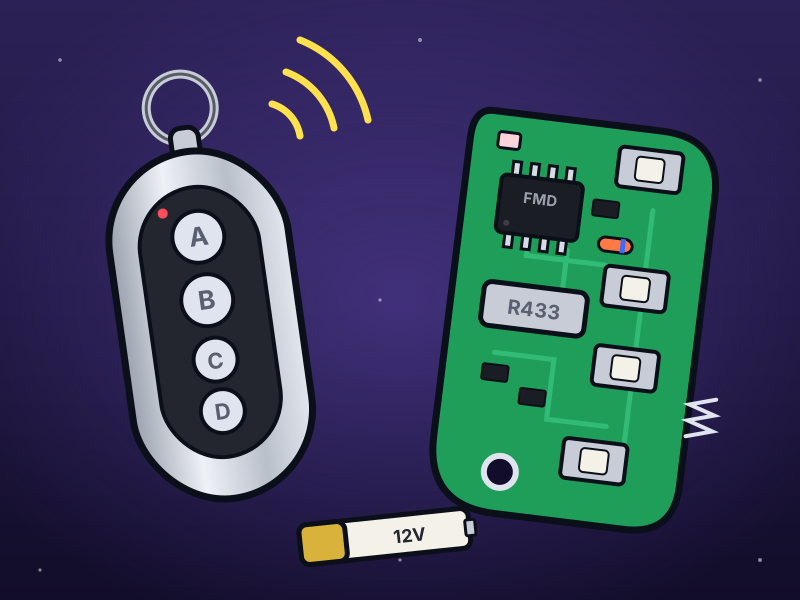
| Sold as | “Universal garage door remote control 433MHZ opener Cloning 4 key … remote control duplicator” |
| Frequency | 433.92 MHz |
| Buttons | 4: A to D on the shell, K1 to K4 on the board |
| Battery | 27A, 12 V |
| Board | 520B V2.1 |
| Microcontroller | FMD FT60E021, 8 pins |
| Transmitter | A 2SC3356 RF transistor with an R433 SAW resonator |
| Antenna | A copper trace printed on the board |
| Code out of the box | Fixed, EV1527 style: 24 bits, a 20-bit ID and 4 button bits, shortest pulse (TE) 340 µs |
| Copies, fixed code (its sheet) | Remotes with these chips: 2260, 2262, PT2264, 5326, SC5262, HT600, HT680, HT6207, HT6010, HT6012, HT6014, SMC918, 527, 1527, 2240 |
| Copies, rolling code (its sheet) | 48 models from 21 brands, among them CAME, Nice, BFT, FAAC, DEA and Beninca: the full list is in the sheet |
| Shell | Chrome and black, a key ring and a clip |
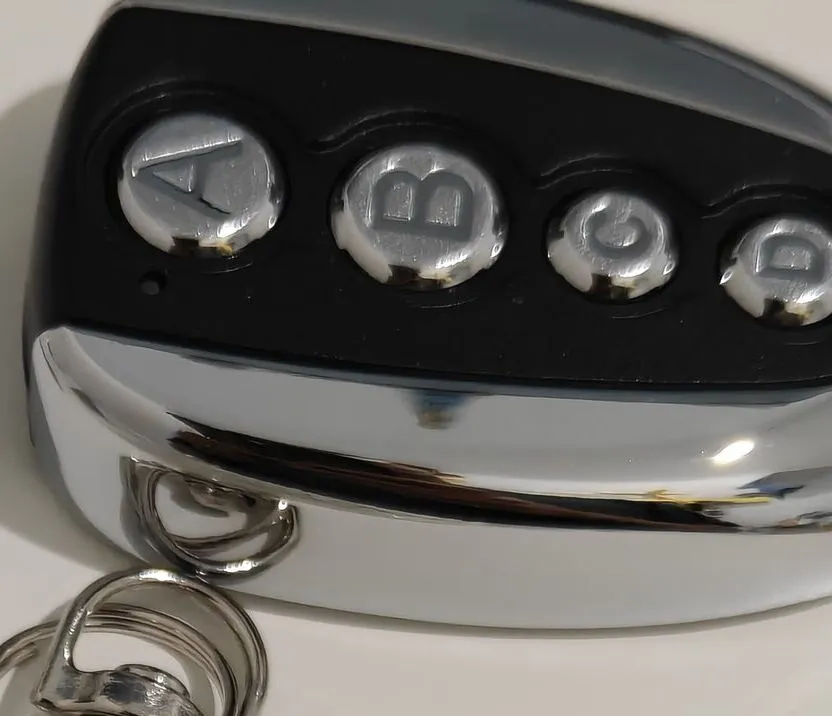
The copy remote.
What it sends
Section titled “What it sends”Out of the box, before it has copied anything, it sends a fixed code: the same bits on every press. My CC1101 scanner decoded all 4 buttons:
| Code | ID | Button bits |
|---|---|---|
0x0B80A1 |
0x0B80A |
0001 |
0x0B80A2 |
0x0B80A |
0010 |
0x0B80A4 |
0x0B80A |
0100 |
0x0B80A8 |
0x0B80A |
1000 |
I haven’t checked which button sends which. A short press sent the code 3 to 7 times, since a remote repeats it while the button is down. On my scanner the presses came in at −18 to −20 dBm, against a noise floor of −88 dBm.
Teardown
Section titled “Teardown”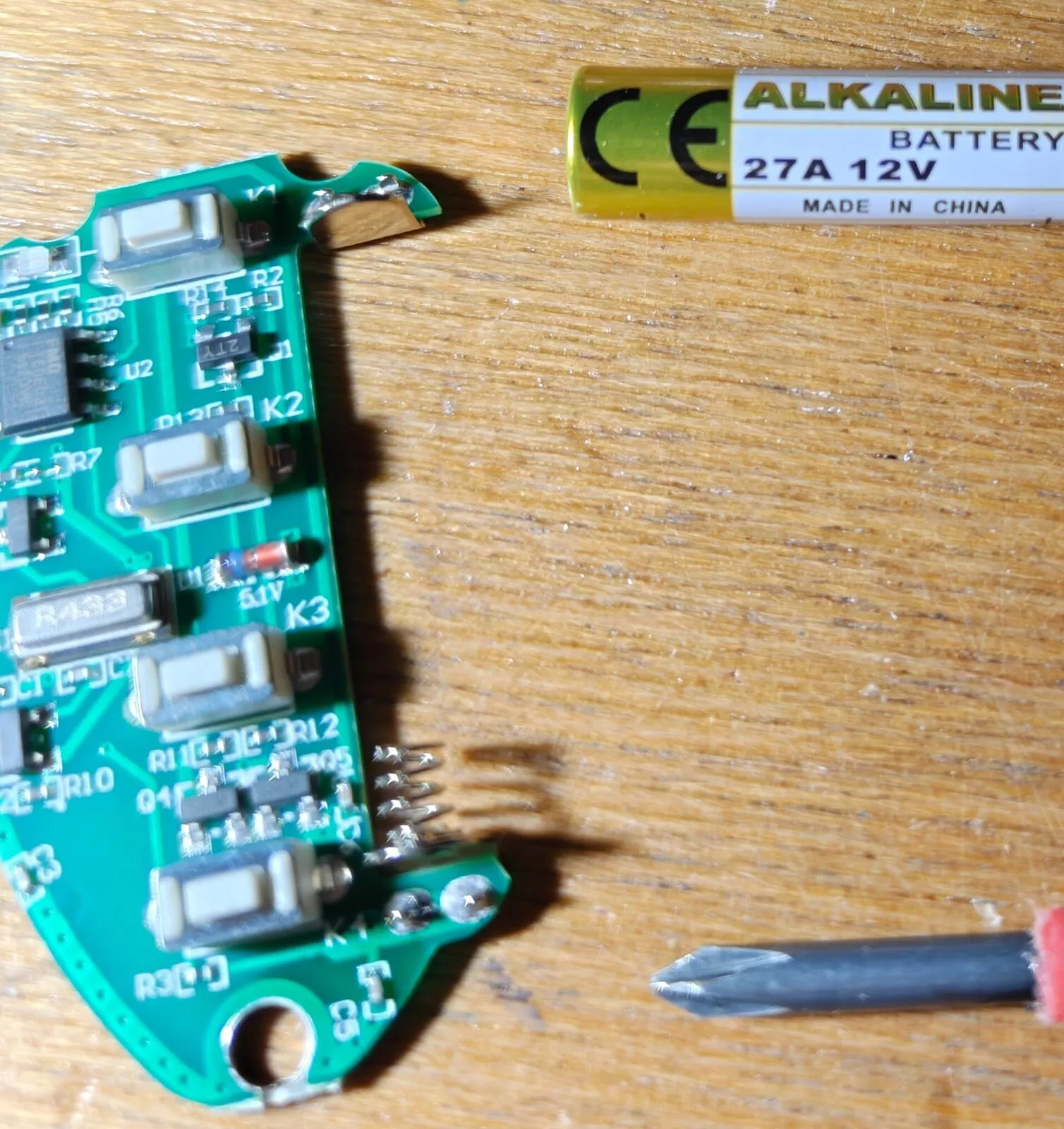
Out of its shell, next to its 12 V 27A battery.
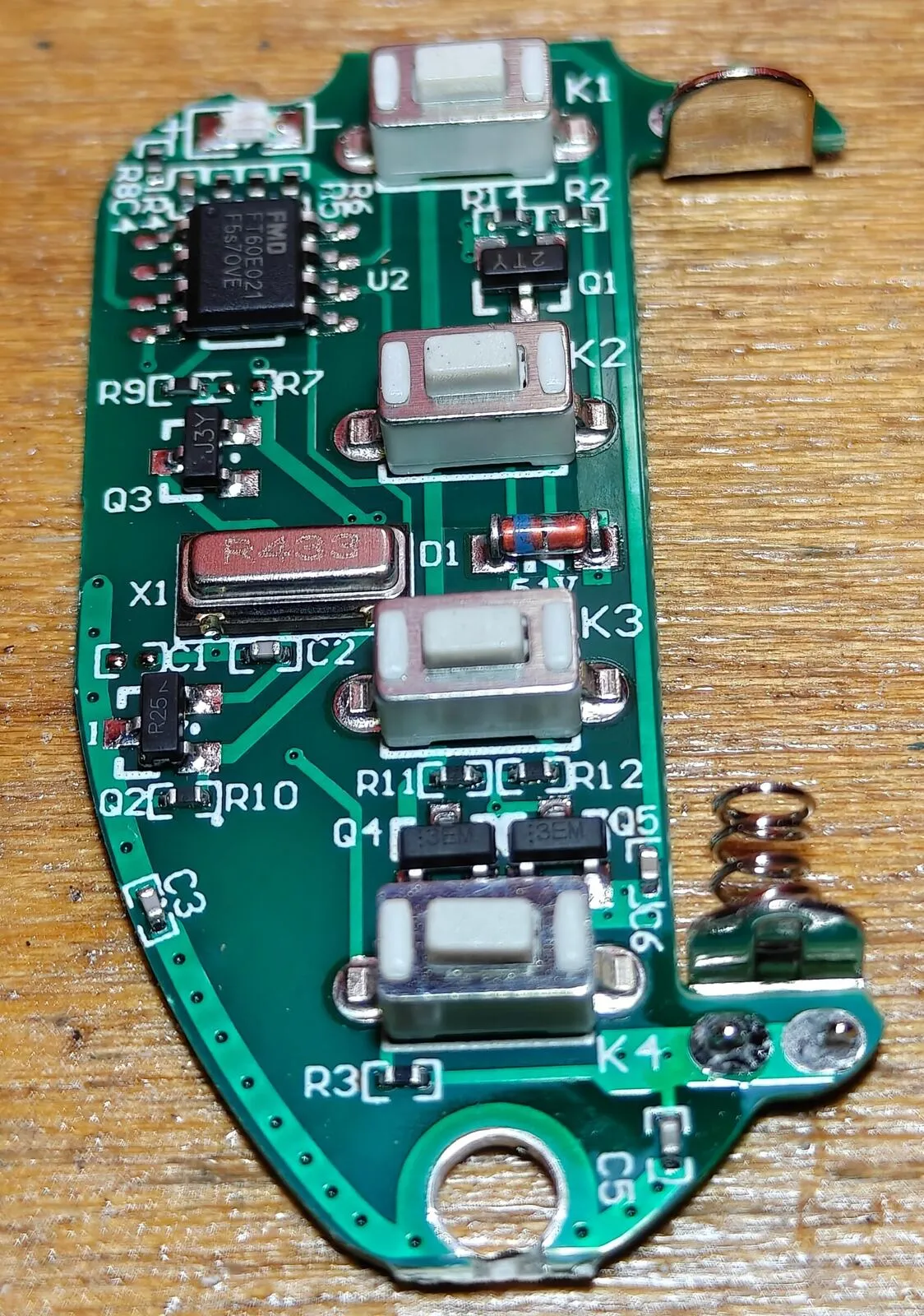
The front: the chip at the top left, the resonator in the middle, the 4 buttons down the right.
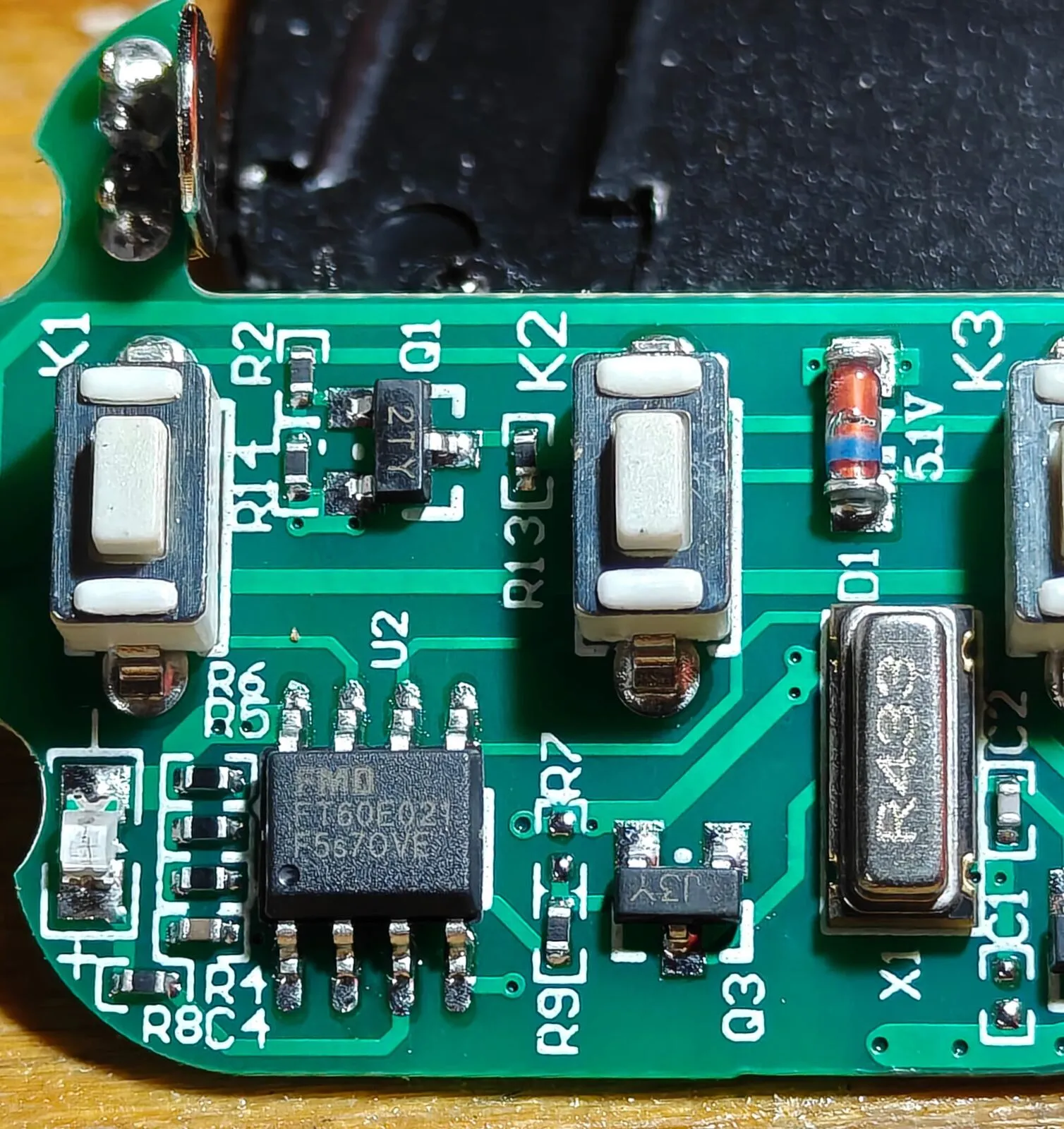
The top half, where the part labels are readable.
The parts, from their markings:
| Part | Marking | What it is |
|---|---|---|
U2 |
FMD FT60E021 |
The microcontroller: reads the buttons, makes the code and keeps the copied codes. It’s the only chip on the board |
X1 |
R433 |
433 MHz SAW resonator: sets the transmit frequency |
Q2 |
R25 |
2SC3356, an NPN RF transistor. With X1 it’s the 433 MHz transmitter |
Q1 |
2TY |
S8550, a PNP transistor |
Q3 |
J3Y |
S8050, an NPN transistor |
Q4, Q5 |
3EM |
Not identified |
D1 |
5.1V |
5.1 V zener diode |
K1 to K4 |
The 4 push buttons | |
| LED | Top left, under a small hole in the shell |
The microcontroller runs on 2.0 to 5.5 V, so it can’t take the battery’s 12 V straight. The 5.1 V zener is probably what holds its supply down.
There’s no receiver chip on the board. That would explain why the sheet wants the two remotes less than 10 mm apart while copying: at that range the original’s signal is strong enough to pick up without one.
The chip
Section titled “The chip”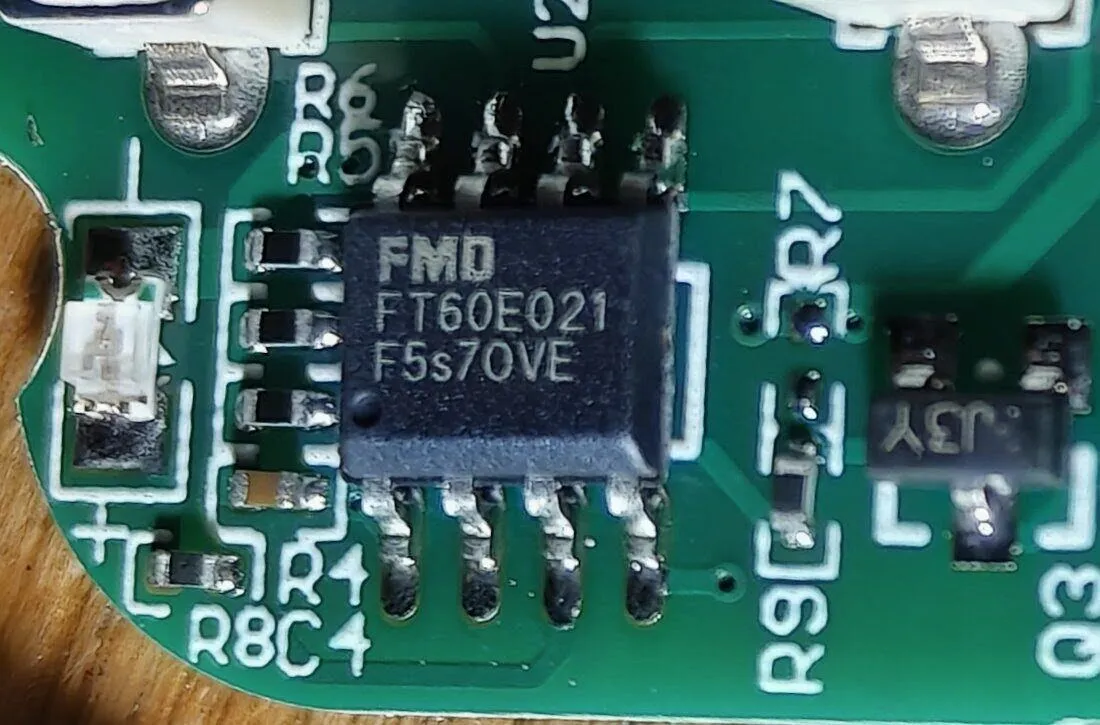
The FMD FT60E021.
The FT60E021 is from FMD’s FT60E02x family: a PIC16-like 8-bit core, 2K words of program memory, 128 bytes of RAM, 256 bytes of data EEPROM, an internal 16 MHz oscillator, 2.0 to 5.5 V. It’s a general-purpose microcontroller, not a remote encoder chip, so everything it sends comes from its firmware. That’s how one chip can send EV1527-style fixed codes and also act as a CAME or Nice rolling-code remote. Our gate remotes have a dedicated KeeLoq encoder instead, Microchip’s HCS300.
The back
Section titled “The back”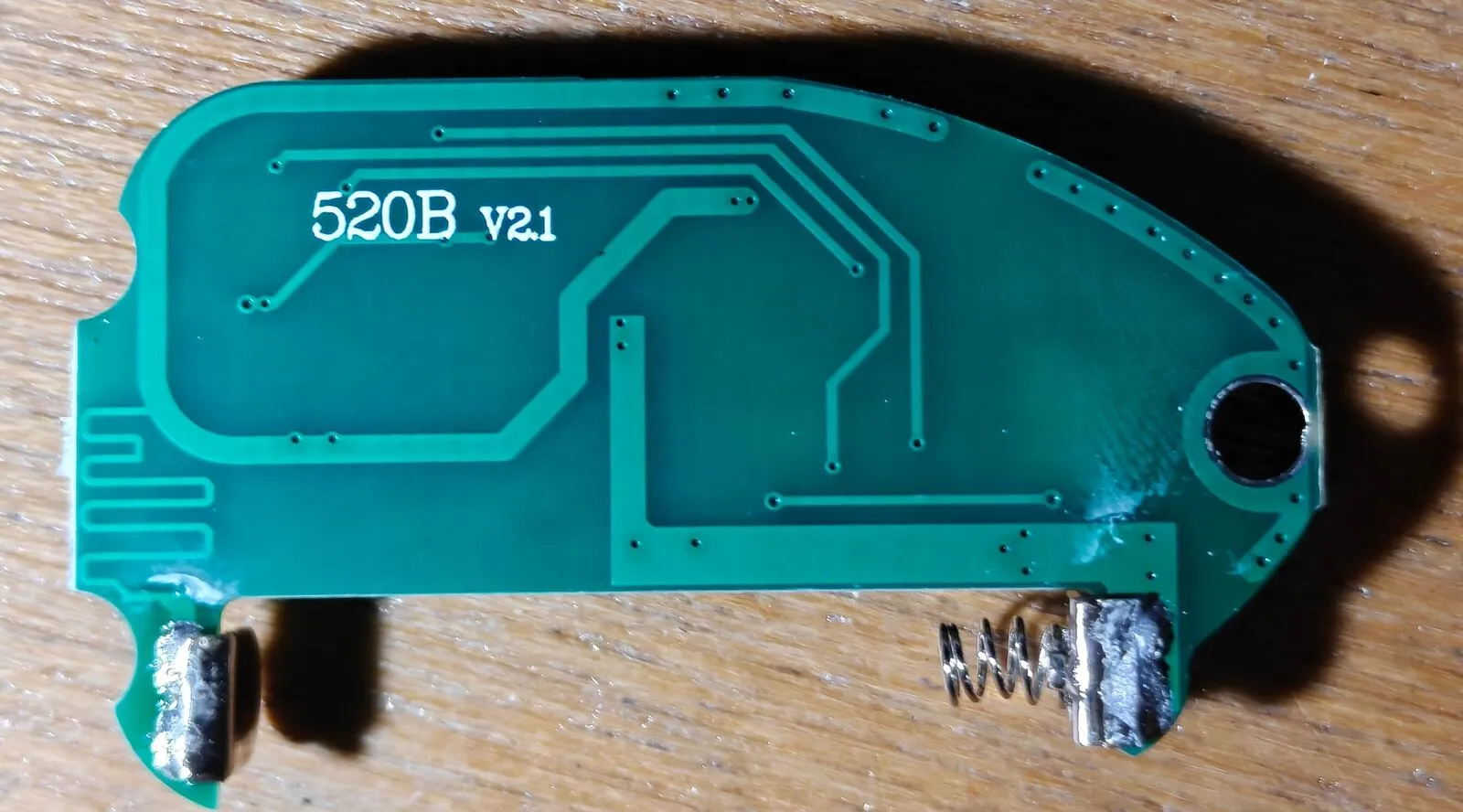
The back: the board name, 520B V2.1, and the printed antenna, the zigzag trace at the left.
The instruction sheet
Section titled “The instruction sheet”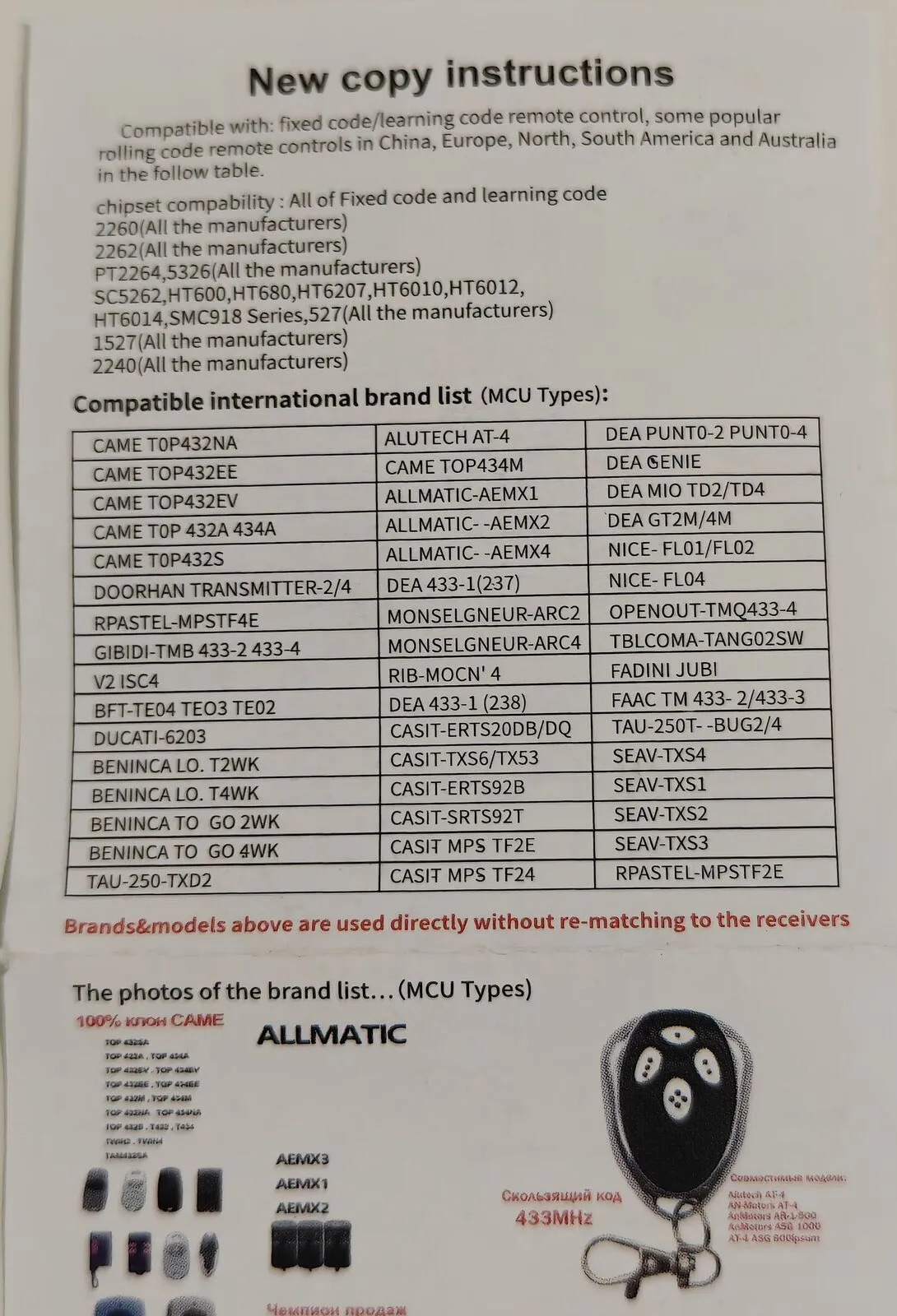
The chips and the rolling-code brands it says it copies.
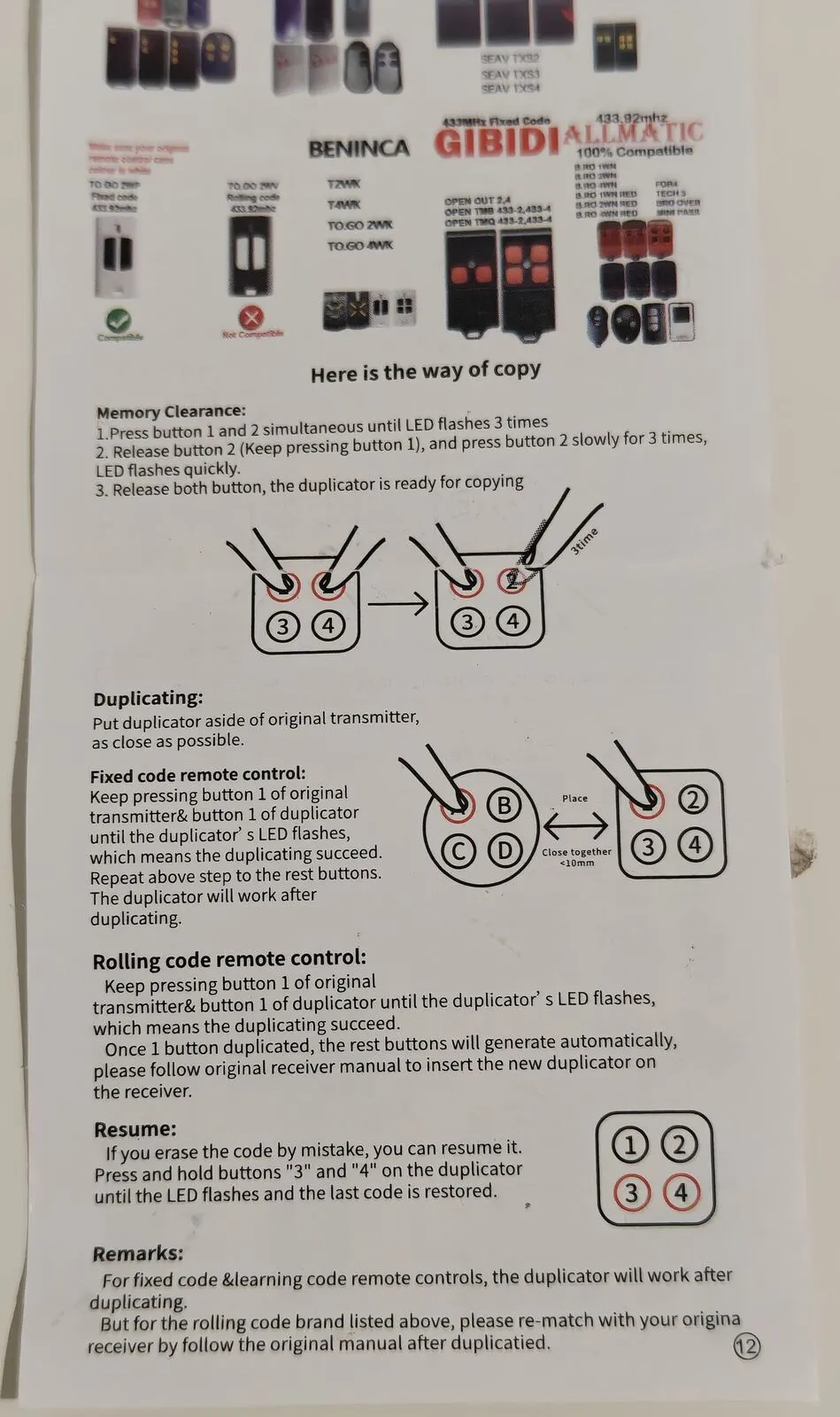
The copy steps.
How to use it, from the sheet:
- Clear it: hold buttons 1 and 2 until the LED flashes 3 times. Keep holding 1, let go of 2, then press 2 slowly 3 times (the LED flashes fast). Let go of both.
- Copy a fixed-code remote: hold the original’s button and the copy’s button at the same time, less than 10 mm apart, until the copy’s LED flashes. Repeat for each button.
- Copy a listed rolling-code remote: the same, for button 1 only. The other buttons follow by themselves. Then pair the copy with the receiver, the way the receiver’s manual pairs a new remote.
- Undo a clear: hold buttons 3 and 4 until the LED flashes. The last code comes back.
These copiers can’t clone a rolling code. For a brand on the list, it works out the brand from one press, then acts as a new remote of that brand, using the brand’s key from its firmware. That’s why step 3 ends with pairing. The sheet contradicts itself here: under the brand table it says those remotes work “without re-matching to the receivers”, and at the end it says to re-match them.
Richmond, our gate’s brand, isn’t on the list.
Used in
Section titled “Used in”- CC1101 on an FT232H: a 433 MHz scanner in the terminal: the test transmitter. Its listen screen decodes the 4 codes above.
Sources
Section titled “Sources”- FMD FT60E02x datasheet (PDF): the FT60E021’s memory and supply voltage
- SMD marking codes:
R25= 2SC3356,J3Y= S8050 and2TY= S8550 - The instruction sheet that came with it (photos above)
Change history
- : First published.
This guide as plain Markdown, for LLMs and scripts: aliexpress-433-mhz-copy-remote.md. All posts: API and Markdown.
Text, photos and drawings: CC BY 4.0. Code: MIT. Share and adapt them, crediting HomeLab Series (blog.jacq.cc). Licence and privacy